Showing posts with label GGI. Show all posts

Monday, September 21, 2015

Where did the 30 minute retention time come from?

It seems today that it is universally agreed to that gravity grease interceptors (GGI) are supposed to be sized based on a 30-minute retention time.

Have you ever wondered where the 30-minute retention time came from? Is there a technical justification for its use? If not then what?

Commercial GGIs are actually residential septic tanks. The reason they work as septic tanks is because they are sized for very long retention times (typically 24 hours) and only have to deal with relatively low flow rates.

The genesis of their use as commercial grease interceptors is difficult to pinpoint, however we do know that beginning with the 1982 edition of the Uniform Plumbing Code (UPC) a methodology for sizing commercial kitchen grease interceptors was developed and placed within Appendix H. The method of sizing calculated meals per peak hour, waste flow rate, retention time and a storage factor. Appendix H was included with each subsequent edition of the UPC through 2003.

In 2006 the UPC removed Appendix H and changed the way GGIs were sized to be based on Drainage Fixture Units. A table was created that assigned a liquid volume amount for the interceptor to predetermined DFU loads. These loads were developed to try to ensure that the liquid amount would provide at least a 30 minute retention time.

The 30 minute retention time was taken from a textbook titled Small and Decentralized Wastewater Management Systems, published in 1998. The authors of that textbook provided the following technical argument for a minimum 30-minute retention time when using a septic tank as a commercial grease interceptor, "Typically, skimming or interceptor tanks are used to trap oils by flotation and grease by cooling and flotation. The contents of the tank serve as a heat exchanger cooling the incoming liquid, which helps to solidify the greases. For flotation to be effective, the interceptor tank must detain the fluid for an adequate period of time (typically greater than 30 minutes)."

That's it.

No research.

No studies.

No evidence that 30 minutes is the right amount of time.

No investigation into the effectiveness of a septic tank as a commercial grease interceptor. Just a statement that 30 minutes or more is adequate to allow for greases to separate in the tank.

Here are some questions to ponder:

How does a 30-minute retention time account for differing flow rates throughout the day? What effect do higher temperature surges have on velocity and flow pattern within the tank? At what point does the accumulated grease and solids effect the separation efficiency? If you travel past the horizon will you fall off the earth? Can you breathe through your nose and mouth at the same time?

You just tried that didn't you?

Since there has never been a technical justification for the use of GGIs, the Water Environment Research Foundation funded a study and published a report titled Assessment of Grease Interceptor Performance in 2008 to investigate the performance of these devices in real world installations.

The study found that GGIs were generally not sized correctly, regardless of whether using the older Appendix H or the newer DFU sizing method, and that they frequently suffered from short circuiting. You can read the report yourself by following this link: Assessment of Grease Interceptor Performance

The problem with the Appendix H sizing method is that it often resulted in over-sized interceptors leading to the generation of lethal amounts of H2S gas as well as elevated BOD and TSS in interceptor discharges.

The problem with the current DFU sizing method is that it often leads to undersized interceptors that short circuit frequently, especially during periods of high flow rates.

If we don't test these devices to understand exactly how they work, the things that negatively effect efficiency and how much actual capacity they have for storing grease and solids, how can we possibly deduce that a 30-minute retention time is adequate for any particular GGI?

The point is that before we go all-in with mandating the use of GGIs, shouldn't we at least do some basic testing to ensure they actually work?

I for one think you can breathe through your nose and mouth at the same time, though I admit that I've only been trying it for the last few minutes.

Monday, June 1, 2015

Regulatory compliance manager; fancy title or job description?

Recent activities I have been involved in have made me think that people really don't understand what it is that I do for a living.

There's no secret that I work for a grease interceptor manufacturer, But, what do I do for Schier?

Am I in sales?  No.

Wait, let me correct that.  I believe everyone is a sales person in one way or another.  For example, my wife would say that she is absolutely not cut out to be in sales.  But when she really wants something, she seems to have no problem presenting me with all of the features and benefits that would justify her request - which usually boil down to me having a happy and contented wife.

Hey, who doesn't want a happy and contented wife?

I generally find that preferable to just about anything else in the entire universe as it tends to provide a much "safer" environment at home.

My kids are some of the best sales people I know, with their mom and dad anyway.  They can be very creative in their justifications for why we should do this thing, or buy that thing, or go to such and such a place, all the while hammering home the features of this or that and the benefits that either they specifically would enjoy or that we all would collectively enjoy together.

Sales is really just the art of persuasion.  Some are naturally more gifted at it than others', and they typically end up selling for a living, but everyone has sold someone something at some point in their life.

Okay, so in the sense of doing "sales" for a living, no, I don't do that anymore. In other words, Schier does not pay me to sell anything.  I can't even tell you what our sales look like anymore because I am very much out of that loop.

So what do I do?

You might say that I am an advocate.

Merriam-Webster's dictionary defines advocate as, "one that defends or maintains a cause or proposal", or "one that supports or promotes the interests of another."

Who or what do I advocate for?

I am an advocate for fats, oils and grease (FOG) abatement in wastewater collection systems to reduce or eliminate sanitary sewer overflows (SSO) and their resultant risks to human health and safety.

That is my job description.  It has taken a while for it to come into clear focus, even for me.

What it means is that, while I am paid to do what I do by Schier Products, I am not paid to promote or sell for Schier Products.

I am in fact paid by Schier Products to advocate for what I think is right for FOG abatement in wastewater collection systems.

The advocacy I do is both internal and external to Schier.

When working with Schier I may advocate for some specific product improvements to make field inspections by pretreatment personnel easier or I might advocate for a new product to solve problems I am seeing in the field.

When working with pretreatment programs I may advocate for improving the requirements in an ordinance, or to remove some restrictive language that will hurt enforcement efforts, or to stop mandating products that are untested for performance.

When working with plumbing codes I may advocate for improved less-confusing-language regarding which fixtures should be routed to an interceptor, or I might take a stand against proposed changes that might lead to conflicts with pretreatment requirements or would loosen restrictions that would, in my opinion, be harmful to wastewater collection systems.

When working with standards such as ASME A112.14.3, I might advocate for more accountability in the standard and less prescriptive design requirements that shackle manufacturers and stifle innovation - something very much needed in grease interceptor design and operation, in my opinion.

I think it's important to understand that I see what I do, not as a job, but as a calling.

I believe in the "cause" of FOG abatement.

When you passionately believe in something you are willing to fight for it. You are willing to take actions that you believe in your heart will make a difference for your cause.

I guess that means that you might ruffle a few feathers. You might not "go along" to get along - if getting along means compromising what you believe in.

That being said, I love engaging with the pretreatment community and others who are equally interested in the issues surrounding FOG deposit formation and the exploration of solutions that might mitigate its deleterious effects.

My job title sure can be confusing, but I take my role in the cause seriously and I welcome the challenges, debates, and struggles that are necessary to make a real difference for us all.

Tuesday, February 10, 2015

2015 IPC Expands Approved Grease Interceptors


The 2015 International Plumbing Code (IPC) has been out since the summer of 2014 and for the first time it has expanded the approved types of grease interceptors to include gravity grease interceptors (GGI) and fats, oils and grease (FOG) disposal systems.

Lets take a look at what's changed and note some problems that will have to be addressed.

Section 1003.3.6 was added to the code as a distinct new category for grease interceptors titled, "Gravity grease interceptors and gravity grease interceptors with fats, oils and greases disposal systems."

Note that these are actually two different categories for gravity interceptors with different requirements for approval.
  • GGIs are required to comply with IAPMO/ANSI Z1001
  • GGIs with FOG disposal systems are required to comply with ASME A112.14.6. 

I have covered all of the recognized standards for grease interceptors previously here: http://theinterceptorwhisperer.blogspot.com/2014/03/the-standards-that-govern-grease.html

As I explain in the post linked above, IAPMO/ANSI Z1001 doesn't have a performance test protocol, but rather only mandates leak testing.

Another problem with the standard is that it doesn't provide any sizing guidelines, which forces specifiers to look elsewhere for help sizing these devices.

The problem with the 2015 IPC is that it doesn't adequately address sizing of GGIs in the new section. Here is what it says, "the required capacity...shall be determined by multiplying the peak drain flow into the interceptor in gallons per minute by a retention time of 30 minutes."

Okay, so which method is approved for determining the peak drain flow into the interceptor?

It doesn't say.

I can outline the options for you though:

Fixture volume
The formula for determining the flow rate from a fixture is as follows: (((LxWxH)/231)*0.75)/1 (1 minute) or (((LxWxH)/231)*0.75)/2 (2 minute).

Calculate the flow rate from each fixture connecting to the interceptor and sum them together and then add the flow rates from any other fixtures, such as dishwashers or woks, etc. This is the maximum flow rate to the interceptor.

Pipe diameter
Using pipe diameter is another method for determining the peak flow rate into an interceptor. Pipe diameters in gravity drainage systems are determined by drainage fixture units (DFU) according to chapter 7 of the code. Maximum DFUs are calculated to ensure that the pipe will never be more than 50% full during peak flow periods. Maximum flow rates in horizontal drainage piping is calculated by Manning's Formula with the following results:


The design flow or half pipe flow values should be selected for sizing GGIs since they represent the peak horizontal flow for each pipe diameter.

The real fun begins when you actually take the peak flow rate you have selected and multiply it by a 30 minute retention time.

This will raise all kinds of interesting questions that your local plumbing inspector may have to answer:
  • When using fixture volume sizing, if the jurisdiction requires a one minute drainage period calculation, how do you account for intermittent use of all of the connected fixtures, since the calculation doesn't account for it?
  • Are you allowed to use a two minute drainage period for fixture volume calculations?
  • Are you allowed to use a two minute drainage period for pipe diameter calculations?
  • What if the jurisdiction mandates 6" diameter drainage piping outside of the building, requiring 6" connections on the interceptor; do you use pipe diameter or fixture volume sizing?
There is another area of the 2015 IPCs new section that bears consideration and that is regarding GGIs with FOG disposal systems.
ASME A112.14.6 does not mandate gravity grease interceptors as the required type of interceptor.  In fact the standard requires separation/retention efficiency in accordance with ASME A112.14.3 which GGIs are not required to be tested and rated to.

The last area of concern in the 2015 IPC is section 1003.3 which states, "Grease Interceptors shall comply with the requirements of sections 1003.3.1 through 1003.3.5, leaving out the new section 1003.3.6.

This oversight leaves the specifier with unclear and vague requirements as stated under 1003.1 and 1003.2 only.  Thus while hydromechanical grease interceptors and automatic grease removal devices have clear requirements spelled out regarding which fixtures are to be routed to them and how to handle food waste disposers and dishwashers, GGIs have no stated requirements.

Hey, even if you get all of that down for your project, regardless how you determine the size of the grease interceptor, how does an owner know that the interceptor is the right one for his facility?

Oh yeah, that's why we developed the Grease Production Sizing Method!

Monday, April 28, 2014

The real difference between Gravity and Hydromechanical grease interceptors

Are you one of those who thinks that Gravity Grease Interceptors (GGI) are better than Hydromechanical Grease Interceptors (HGI) because they are so much bigger?  Have you bought into the myth that GGIs can handle all of the flow of a commercial kitchen while HGIs should only be allowed in small kitchens with few fixtures?

You are not alone.  

After decades of use, people just accept assumed differences between GGIs and HGIs as actually existing.

I'd like to point out the similarity between these two types of grease interceptors because this will make it easy to identify mythical assumed differences for what they are

They both use gravity-differential separation
Have you ever jumped into the air and not landed on the ground again?  Unless you live somewhere other than on planet earth, you are subject to gravity the same as the rest of us.

If there is no gravity then the earth doesn't revolve around the sun, the moon doesn't revolve around the earth and there is no point in reading any further because there is no such thing as human beings either, which means no one needs to be concerned about how grease interceptors work.

My guess is that we have all proven that gravity exists at least once in our lives.

An object with a specific gravity of less than one will float in water while an object with a specific gravity of greater than one will sink.  This is also very easy to prove.  Here is a list of some common specific gravities:


If you are going to experiment with any of these, I recommend you properly dispose of them when you are finished as most of these are prohibited from discharging to sanitary sewer systems, at least here on earth (if you are not here then you may need to check your local planetary requirements on that).

Gravity-differential separation simply means to use the differences in specific gravities of restricted pollutants, such as fats, oils and grease (FOG) as the means of separation from water inside an interceptor.

Grease poured into a static body of water will rise very quickly to the surface based on the size of the bubbles formed, their specific gravity, their viscosity and the temperature of the grease and water. The rise rates of the bubbles is predictable according to Stokes law.

The difference between a static body of water and a grease interceptor is that the water in the interceptor is not static.  The discharge from a connected fixture will have a flow rate that must be dealt with in a grease interceptor.

A Symposium on Grease Removal titled Design and Operation of Grease Interceptors by Frank Dawson and A.A. Kalinske, published in 1944 explains the fundamentals of gravity-differential separation in grease interceptors as follows:

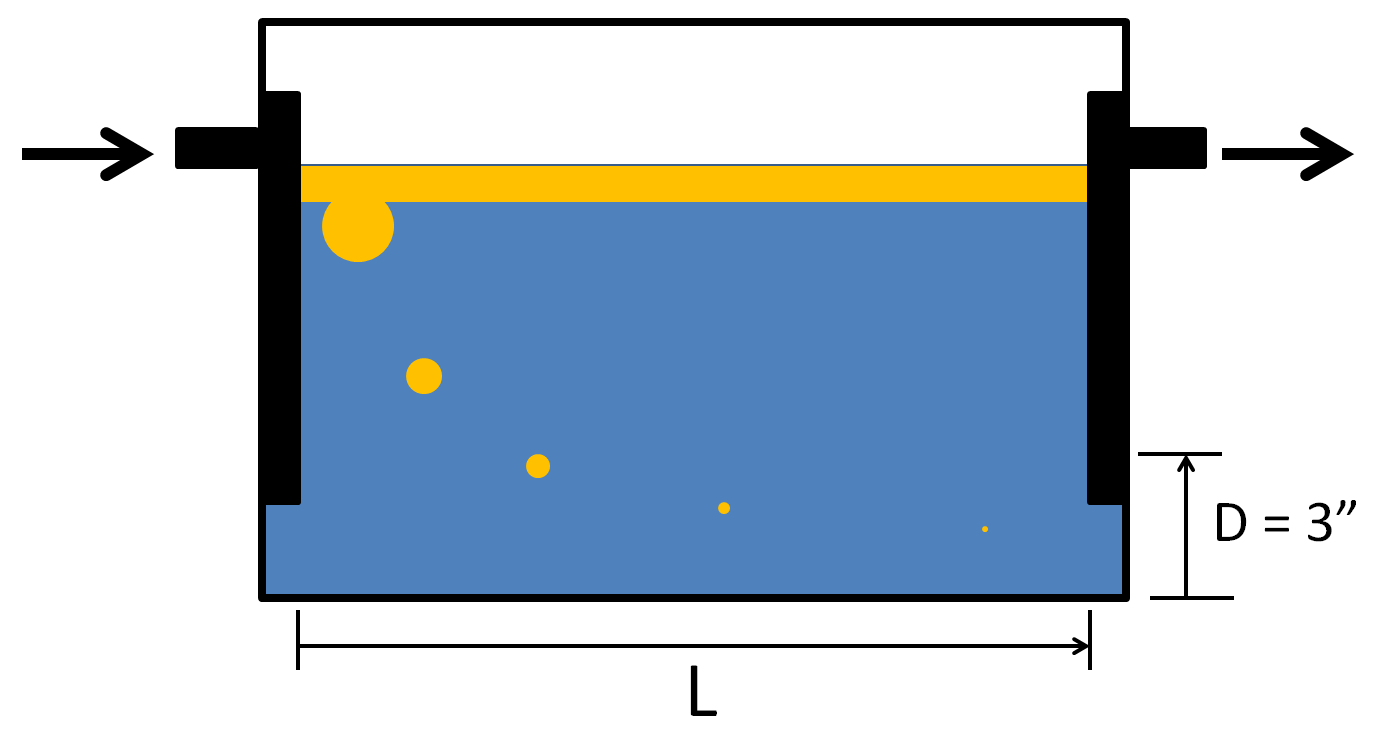
"For simplicity let us assume that pure grease and water enter near the bottom of a rectangular-shaped interceptor L feet long, B feet wide, and with a water depth of D feet.  The interceptor will do a good job of separation if, as the flow goes through the interceptor, the mean velocity of flow is such as to permit the grease globule to rise a vertical distance D in a length of L feet."

Dawson et al. went on to say, "If we neglect, for the moment, the presence of turbulence we see that the controlling item in the sizing of the interceptor for any particular rate of flow is the rate of rise of the grease globules. If the size of the globules is known, the maximum velocity of rise can be calculated readily from known principles of fluid mechanics, by equating the buoyant force on a globule to the force of fluid resistance."

If I keep quoting Dawson et al. we are all going to be asleep soon. So let me paraphrase from here. Velocity is the speed that the fluid is moving across the interceptor.  If the fluid moves too quickly the smaller grease globules are less likely to have time to rise an adequate distance to remain in the interceptor.  This makes velocity a key to good interceptor design.

The American Society of Plumbing Engineers (ASPE) established three inches as the minimum distance D that a grease globule must rise in a length of L in an interceptor to be retained (ASPE Plumbing Engineering Design Handbook 4, Plumbing Components and Equipment, Chapter 8 Grease Interceptors).

Gravity-differential separation applies to any grease interceptor regardless of manufacturer or type. HGIs must be designed based on this principle and so do GGIs.

No exceptions.

So what is the assumed difference?
That HGI's use controlled flow and some other stuff, most of which is bunk (counter-current flows, bernoulli's equation, etc.), to do what GGIs do with retention time.

Assumption debunked.

HGIs control the incoming flow and distribute it throughout the cross-sectional area reducing the fluid velocity to allow for gravity-differential separation at the maximum rated flow of the interceptor.

GGI's do not!

This is basic physics.

GGIs simply take whatever flow is dumped into them and everyone assumes that, no matter what, the GGI can handle it.

Sorry, it ain't possible.

Uncontrolled inlet velocity and the associated turbulence causes short-circuiting at higher flow rates in GGIs. This is not to say that GGIs don't work.  At lower flow rates they work very well because turbulence decay happens rapidly at low flow rates.  At higher flow rates though, turbulence decay happens over an exponentially longer time.

Experiments by the Water Environment Research Foundation, included in their 2008 report Assessment of Grease Interceptor Performance, demonstrated that residence times of at least one hour were more conducive to turbulence decay in the standard IAPMO approved GGI (Z1001) design.

When everyone finally steps back long enough to think clearly about how all grease interceptors must actually work - we will finally be able to start focusing on what is really important in an interceptor (hint - it isn't how much water it can hold).

When everyone starts focusing on how efficient a grease interceptor is and how much grease it can hold instead of how much water it can hold, we wont need to worry about whether its called an HGI or a GGI because all grease interceptors will be just grease interceptors.

HGIs will not hold just 2 lbs of grease for each 1 gpm of flow rate - because to keep up with competition, they will have to hold 5 times as much or 10 times as much or even more!

If GGIs are the FOG abatement solution of the future then the earth doesn't revolve around the sun and the moon doesn't revolve around the earth and we don't exist either, which is weird because my back hurts.

Wednesday, April 2, 2014

How do Gravity Grease Interceptors Work and How Efficient are they?

Many jurisdictions across the United States either favor exterior gravity interceptors or outright mandate them, some going as far as disallowing hydromechanical grease interceptors altogether.  

I get it.  I understand why.  Jurisdictions are frustrated!

For many decades grease traps (now called hydromechanical grease interceptors - HGI) have been the primary pretreatment device prescribed by plumbing codes to be installed in commercial food service establishments to prevent grease from entering the collection system.

If they work so well, why have jurisdictions been having so many issues with the buildup of FOG in collection systems?  

A simple inspection of the restaurants in a lot of jurisdictions will reveal a significant number of undersized indoor grease interceptors that are connected only to a multi-compartment sink and are not being maintained frequently enough.  

Hey, Americans are some of the best ditch divers (going from one extreme to another) in the world.  If the problem is allowing restaurants to install undersized grease interceptors inside the kitchen, then the "fix" is only allowing swimming pool sized gravity interceptors outside, right?!

How efficient are these giant interceptors?  How much grease will they hold?

I have asked jurisdictions across the country from sea to shining sea these same questions for the past 5 years, and you know what the answer always is?  "I don't know" - that's the answer. No one knows.  

How is it possible that we have jurisdictions mandating and in some cases only allowing the installation of interceptors whose efficiency and grease storage capacities are unknown?

I suppose the most common argument I hear is that basic physics justify their approval.  Okay, what physics are we talking about?  Stokes law.  The universally accepted answer as to why gravity interceptors work is because of Stokes law and retention time.

Really?  Okay, so what is Stokes law and how does it work?

Stokes law explained
The American Society of Plumbing Engineers (ASPE), Plumbing Engineering Design Handbook 4, Plumbing Components and Equipment, covers grease interceptors in chapter 8. Regarding Stokes law it has this to say on page 153: 


"An examination of this equation shows that the vertical velocity of a grease globule in water depends on the density and diameter of the globule, the density and viscosity of the water, and the temperature of the water and FOG material. Specifically, the grease globule's vertical velocity is highly dependent on the globule's diameter, with small globules rising much more slowly than larger ones. Thus, the larger the globule, the faster the rate of separation."


Table 8-1 Droplet Rise Time
Travel Time for 3" Distance at   68 deg F (hr:min:sec) Travel Time for 3" Distance at   68 deg F (hr:min:sec)
Droplet Diameter (microns) Oil (rise time) SG 0.85 Droplet Diameter (microns) Oil (rise time) SG 0.90
300 0:00:12 300 0:00:15
150 0:00:42 150 0:01:03
125 0:01:00 125 0:01:27
90 0:01:54 90 0:02:54
60 0:04:12 60 0:06:36
50 0:06:18 50 0:09:18
40 0:09:36 40 0:14:24
30 0:17:24 30 0:25:48
20 0:38:46 20 0:58:08
15 1:08:54 15 1:43:22
10 2:35:02 10 3:52:33
5 10:02:09 5 15:30:14
1 258:23:53 1 387:35:49

In the table above ASPE calculated the different rise rates of grease globules based on size in microns, and two different specific gravities (SG) - 0.85 and 0.90, showing how long it would take them to rise 3 inches at 68 deg. F.

Quoting ASPE again:

"Due to reliance on gravity differential phenomena, there is a practical limitation to interceptor effectiveness. In terms of grease/oil globule size, an interceptor will be effective over a globule diameter range having a lower limit of 0.015 centimeter (150 microns)."

Stokes law is fairly straight forward with one catch; it calculates the rate of rise of a grease globule in static (not moving) water. Does a grease interceptor, whether HGI or gravity, contain static water? Obviously not.  Either type of interceptor will have fixtures draining waste water into them at some flow rate.  How does this flow of waste water affect the calculation of Stokes law?

We need to understand the difference between laminar and turbulent flow before attempting to ascertain their affect on the calculation of Stokes law.

According to the Encyclopedia Britannica:
Turbulent Flow

  • Turbulent flow is fluid flow in which the fluid undergoes irregular fluctuations, or mixing. The speed of the fluid at a point is continuously undergoing changes in magnitude and direction, which results in swirling and eddying as the bulk of the fluid moves in a specific direction.
  • Laminar flow is fluid flow in which the fluid travels smoothly or in regular paths. The velocitypressure, and other flow properties at each point in the fluid remain constant. Laminar flow over a horizontal surface may be thought of as consisting of thin layers, all parallel to each other, that slide over each other. 
It is impossible to accurately predict the rise rate of a globule of grease in a turbulent flow environment because the turbulent flow acts to re-entrain the grease into the flow path negating the buoyant forces that are acting to lift the grease globule to the surface (depending on its size of course).

The advantage of a laminar flow environment is that the flow has very little effect (adding drag) on the buoyant forces acting on a grease globule.

Quoting again from page 155 of the same ASPE handbook:

"The ability of an interceptor to perform its primary function depends on a number of factors. These include the type and state of FOG in the waste flow, the characteristics of the carrier stream [turbulent vs. laminar], and the design and size of the unit."

Quoting from a paper published in 1944 titled Symposium on Grease Removal, Design and Operation of Grease Interceptors, by F.M. Dawson and A.A. Kalinske: 


"For simplicity let us assume that pure grease and water enter near the bottom of a rectangular-shaped interceptor L feet long, B feet wide, and with a water depth of D feet. The interceptor will do a good job of separation if, as the flow goes through the interceptor, the mean velocity of the flow is such as to permit a grease globule to rise a vertical distance D in a length of L feet."

Let's go back to our ASPE handbook:

"The ideal separation basin is one that has no turbulence, short-circuiting, or eddies.  The flow through the interceptor is laminar and distributed uniformly throughout the basin's cross-sectional area."

Distributing the flow uniformly throughout the basin's cross-sectional area reduces velocity which allows more time for a grease globule to separate inside the interceptor before reaching the outlet and escaping.  The velocity of the flow is reduced proportional to the extent to which it is uniformly distributed throughout the basin's cross-sectional area. 

The question is; do gravity interceptors have a laminar flow path and do they uniformly distribute the flow throughout their cross-sectional areas?
IAPMO/ANSI Z1001 Gravity Grease Interceptor

Here is what the standard gravity interceptor design looks like; the design that is mandated by IAPMO/ANSI Z1001 (formerly PS-80) and approved by model plumbing codes and most jurisdictions:

According to the Water Environment Research Foundations' 2008 report Assessment of Grease Interceptor Performance:  


Figure 5-18
"The standard configuration [IAPMO/ANSI Z1001] displayed substantially poorer performance than any of the other simulations (56.7%). Close observation of the velocity contours (Figure 5-18) of the cross-section within the reactor suggests that the cause for this reduced performance may be due to higher local velocities near the inlet, baffle, and outlet pipes, all contributing non-quiescent (turbulent) flow conditions...Further examination of the velocity contours in the direction of flow (Figure 5-19) suggests several regions of high velocity along the bottom of the tank and along the side walls."


WERF is essentially saying that at higher flow rates the lack of any control over the flow in gravity interceptors exacerbates turbulence and horizontal velocity leading to short-circuiting.


Figure 5-19
The simulations and bench tests pictured in Figure 5-18 and 5-19 represent a 20 minute retention time, which would be 50 gpm entering a 1000 gallon gravity interceptor. That is obviously a significant amount of flow and in fairness is higher than the average flow rate from most FSEs.


WERF's 2008 report also documented Grease Interceptor Influent Fluid Flow Analysis conducted on several different food service establishments (FSE) in Table 4-3 page 4-8.  The data collected included the total flow to the grease interceptor, the maximum flow-rate measured, the average flow-rate for the measurement period, and the size of the interceptor, among other things.


The outlier on maximum flow-rate across all restaurants was 45 GPM at a ‘full service steak house’. The average flow-rate at this same restaurant was 9.8 GPM.  The second highest flow-rate recorded was 35 GPM at a ‘full fare – Italian’ restaurant and the average flow-rate for this FSE was 9.4 GPM. The average flow rate for all restaurants was 2.8 gpm.

It is important to understand that the flow rates from these FSEs have low averages because restaurants don't typically fill up all their sinks and dump them repeatedly all day long.  Normal kitchen operations have some flow associated with both cooking and cleaning throughout the day, however, when they pull the drain plugs at the end of a meal period or the end of the day - this is when they will have a significant amount of flow at higher temperatures.

Based on all of the factors that effect grease interceptor performance, we would expect that a gravity grease interceptor would perform well at the average flow rates of most restaurants. However, we should also expect them to have problems with short circuiting at higher flow rates, and this is in fact what WERF reported finding in their analysis of interceptors in real world installations.  

Conclusion
On page 156 of the handbook we've been referring to here, ASPE explains:

"you can improve the grease interceptor by increasing the interceptor volume or reducing flow and subsequently lowering horizontal velocity and increasing retention time within the interceptor."

Therefore, gravity interceptors will actually need to be bigger in order to prevent short circuiting at higher flow rates - a decision that has consequences both positive and negative (i.e. better efficiencies but H2S gas generation).

Hydromechanical interceptors, though smaller in size and volume, have the advantage of being able to control the entering waste stream creating a laminar flow environment and distributing that flow more or less uniformly throughout their cross-sectional area, thereby reducing horizontal velocity and increasing flow through time.  This is why they are a viable alternative to larger gravity interceptors.

The challenge is to ensure that they are sized to have all of the kitchen fixtures routed to them, in order to avoid inadvertent bypass, and then to make sure they are maintained properly -(both subjects of another post).

Tuesday, March 11, 2014

The Standards that govern Grease Interceptors (all types) in North America

UPDATED (June 2014)

When it comes to grease interceptors there are a variety of recognized standards that have been developed over the years that govern performance requirements, construction requirements or both. This post will explore all of the available standards for North America and the types of interceptors they govern.


PDI-G101
This standard governs passive hydromechanical grease interceptors.

PDI stands for the Plumbing and Drainage Institute which is an association of manufacturers of plumbing and drainage products. In the early 1940's PDI was called the Plumbing and Drainage Manufacturers Association and members of the group joined with representatives of the Quartermaster General, Surgeon General, Army Corp of Engineers and researchers from the Iowa Institute of Hydraulic Research to develop a testing program to establish flow rates and grease holding capacities for uniform rating of grease interceptors.

Using the guidelines established in Iowa, the Research Committee continued the testing program at The United States Testing Company, Inc., which culminated with the first issue of this Standard in 1949 and certification of applicable grease interceptors.

Test apparatus used by PDI and ASME
Interceptors are tested and rated for efficiency and grease storage capacity. Approved interceptors will have a minimum average grease removal efficiency of 90% and will retain not less than 2-1/4 lbs of grease for each one gpm of certified flow rate at either the interceptors Rated Grease Capacity per Table 1 below (with a 12.5% safety factor) or at the interceptors Maximum Grease Capacity by determining the break down point.

Certification to a Rated Grease Capacity allows a manufacturer to test their unit through 13 cycles and whether "full" of grease or not, so long as the interceptor meets the requirements for efficiency and the minimum grease capacity per Table 1, it will be certified at the Rated Grease Capacity per Table 1.

The standard also allows a manufacturer to have an interceptor tested to break down to determine its Maximum Grease Capacity. It must meet the same efficiency requirements and minimum grease capacity as an interceptor with a Rated Grease Capacity and so long as it does, it will be certified.

Interceptors that are certified to a Rated Grease Capacity and those certified to a Maximum Grease Capacity are required to label their interceptors the same according to Table 1 above. This essentially discourages manufacturers from continuing to test an interceptor beyond 13 cycles to determine the interceptors break down point because the interceptor will still be certified and listed to the same performance as a Rated interceptor. This makes it difficult to determine if an interceptor certified to PDI-G101 actually exceeds the minimum requirements.


This standard also mandates the use of an external flow control with integral air vent (which provides air entrainment to aid grease in separating from the entering waste stream) and internal baffles or barriers. Currently the standard does not allow for any alternative design elements, which discourages innovation.
Lastly, the standard provides language that would imply that a manufacturer could have an interceptor tested and rated to flow rates in excess of 100 gpm. Unfortunately PDI does not have the ability to actually perform the testing at this time. Currently the maximum flow rate of any interceptor certified to this standard is 100 gpm.

This is the most widely used, recognized and approved standard in North America.

According to PDI's website (www.pdionline.com) there are 24 manufacturer's with grease interceptors certified to this standard.

PDI G-102
This standard sets requirements for how grease interceptor sensing and alarm devices perform to signal that the interceptor is approaching its rated capacity.

ASME A112.14.3
This standard governs passive hydromechanical grease interceptors.

According to the foreword, “In 1994, the Plumbing and Drainage Institute agreed to work with the American Society of Mechanical Engineers for the development of this Standard. This Standard includes criteria for testing and rating of grease interceptors; general requirements for these appurtenances; and an appendix of valuable sizing, installation, and maintenance data.”

Regarding the scope of the Standard the foreword states, “…this Standard is limited to units of 100 gallons per minute (gpm) or less in rated capacity.”

One of the significant differences between PDI G-101 and this Standard is that while PDI G-101 interceptors are restricted to design requirements that include a vented external flow control and internal baffles, this standard classifies interceptors with these design elements as Type “A” Rated.

Type A – Units with external flow control, with air intake (vent), directly connected
Type B – Units with external flow control, without air intake (vent), directly connected
Type C – units without an external flow control, directly connected
Type D – units without an external flow control, indirectly connected

I am not aware of any manufacturer who has certified an interceptor to Type B at this time.

Schier Products Great Basin series and Thermaco's Trapzilla series are the only grease interceptors currently certified to Type C. Canplas' new Endura XL series, which they are advertizing as available this fall, also utilize built-in flow control conforming to Type C.

I am not aware of any manufacturer who has certified an interceptor to Type D at this time.

While the testing under ASME A112.14.3 is identical to that under PDI G-101, there are a couple of differences in performance and rating requirements:

PDI G-101 requires an interceptor to hold 2-1/4 lbs of grease for each one gpm, while the ASME standard only requires 2 lbs for each one gpm.

PDI G-101 allows for either Rated Grease Capacity or Maximum Grease Capacity, while ASME only allows for Maximum Grease Capacity.

ASME A112.14.3 is listed and approved by the Uniform Plumbing Code (UPC), the International Plumbing Code (IPC) as well as the National Standard Plumbing Code (NSPC) and most independent state plumbing codes.

ASME A112.14.4
This standard was first published in 2001 and is the only recognized standard in North America governing automatic grease removal devices (GRD).

The devices required to meet this standard must automatically remove fats, oils and grease from the separation chamber to a point outside of the GRD in a container capable of holding 150% of the interceptors rated capacity. The removal process is supposed to ensure that the removed FOG is 95% free of water, by volume.

The standard mandates that GRDs first be tested and rated according to ASME A112.14.3 to establish that the interceptor's separation chamber can hold 2 lbs of grease for each one gpm of flow rate. Then the standard employs an additional test to ensure that the GRD's collected grease can meet the required percent of water content, not to exceed 5%.

ASME A112.14.6
This standard was developed to address a growing category of interceptors that not only separate and retain FOG, but internally dispose of retained FOG by means of mass and volume reduction through thermal, chemical, electrical and biological processes.

The standard allows for the use of hydromechanical grease interceptors meeting either PDI G-101/ASME A112.14.3 or gravity grease interceptors meeting IAPMO/ANSI Z1001.

Acceptable performance, under the test parameters of this standard, is an effluent concentration limit of 100 mg/L (PPM) as determined using USEPA Method 1664.

CSA B481
This is a consensus standard published by the Canadian Standards Association in 2007 governing hydromechanical grease interceptors. It is a more comprehensive standard that governs material requirements, construction requirements, test methods and performance requirements, marking requirements and sizing guidelines.

CSA both publishes Standards and offers testing and certification services to those standards for a fee.  They also allow other certified/approved agencies to test and certify to their standards.  Testing agencies have their own identifying mark as follows:


This mark identifies an interceptor that has been tested and rated by CSA Group to CSA B481.


This mark identifies an interceptor that has been tested and rated by IAPMO to
CSA B481.
 
This standard offers two different types of ratings; B481.1 and B481.2.

CSA B481.1 Testing and rating of grease interceptors using lard
This certification specifically requires testing to ASME A112.14.3 for the interceptors flow rate and rated capacity and requires the interceptor to be marked with its removal efficiency, flow rating, and maximum grease containment capacity.

CSA B481.2 Testing and rating of grease interceptors using oil
This certification uses effluent concentration sampling for testing the interceptor. The test requires the interceptor to be filled with water first, then have crushed granite added up to the interceptors maximum solids capacity (unless the interceptor is not designed to capture and contain solids), then fill the interceptor with sunflower oil to the point at which 5 test cycles of 12,000 mg/L will fill the interceptor to its rated capacity.

Then the interceptor is tested 5 cycles with the oil mixture in the prescribed concentration and the interceptor’s effluent is sampled multiple times during the cycle. Whatever the average is of the concentration of oil in the effluent grab samples is recorded as the average efficiency for the interceptor in mg/L.

For demonstration purposes let’s say an interceptor’s first cycle has an average effluent concentration of 100 mg/L, 2nd cycle its 120 mg/L, 3rd cycle its 130 mg/L, 4th cycle its 175 mg/L, and 5th cycle its 225 mg/L. The interceptors overall average efficiency would be 100 + 120 + 130 + 175 + 225 = 750 divided by 5 for an average of 150 mg/L. The manufacturer would then be required to post the interceptors Effluent Grease Concentration as 150 mg/L on its label.

There is no predetermined concentration limit that triggers a pass or fail. The test simply requires the manufacturer to list the grease concentration limit as an average of the recorded test results.

There are no certified grease interceptors that meet this standard today.

ASTM C 1613
This is a standard specification for Precast Concrete Grease Interceptor Tanks. It governs the type of cement, method of manufacturing as well as structural and physical design and construction requirements including: the shape and capacity of the tank, number of compartments, location of baffles, minimum and maximum liquid height, volume of free airspace, size and location of manhole covers, and so on.

The only testing requirement contained in the standard is for water-tightness. There is no performance test requirement.

This is not an approved standard in either the Uniform Plumbing Code nor the International Plumbing code.

IAPMO/ANSI Z1001
This is the primary standard governing gravity grease interceptors (GGI), recognized by national model plumbing codes and most independent state plumbing codes. It governs design requirements such as a minimum of two compartments, minimum liquid volume of 300 gallons, minimum free airspace, size and location of manholes covers, and so on. It also governs construction material requirements including concrete, fiberglass, polyethylene and coated steel.

The major drawback to the standard is that it does not require a performance test for certified units, but rather only mandates leakage testing.

Future work on this standard should focus on developing a test protocol to justify detention time based sizing methodologies.

Now you know all of the standards that govern grease interceptors today, the types of interceptors or technologies that are covered and the basic requirements contained in each standard.