Showing posts with label flow control. Show all posts

Tuesday, July 1, 2014

The Grease Interceptor Revolution

They say that imitation is the sincerest form of flattery, which sounds good to me, although I'm not sure who 'they' is.

If it's true, then the Schier team should be blushing, based on whats been happening in the world of grease interceptors recently.

Let me explain (or as Ricky Ricardo used to say, "esplain").

Schier Products is leading a grease interceptor revolution!

Prior to 2006, when Schier launched the Great Basin series, there had been little change in the way grease 'traps' were manufactured and certified. 

Prior to the year 2000, the only standard governing these devices was PDI G-101, which was originally published in 1949 and was based on research conducted at the Iowa Institute of Hydraulic Research (IIHR) in the early 1940s.

Even before the PDI standard was launched, the IIHR had been conducting testing on grease interceptors and had developed a rating system.  Any type of grease interceptor, before it could be installed in an army camp kitchen, had to have a rating certificate from IIHR.  

The image to the left is a schematic of the IIHR test apparatus.  

What was significant about the testing and rating that had been developed at the IIHR was the initial focus on army camp kitchen installations.

It was the army which had requested a standard that could be incorporated into its specification for grease interceptors, MIL-T-18361 (cancelled in 1982), because in the absence of a standard, ratings were determined by each manufacturer for their own interceptors.

IIHR Certified interceptors were required to meet the following minimum performance standards under the test parameters:
  • Must have a minimum 90% average efficiency
  • Must separate and store 2 lbs of grease for each gpm of flow at the minimum average efficiency.
Since the focus of the research was grease interceptor sizing and rating for army camp kitchens, the researchers created Table B (at right) listing the type of fixtures and recommended minimum rate of flow capacity for any interceptor that would be connected to those fixtures.

This created a problem.

It placed emphasis on how much flow an interceptor could receive while meeting the minimum efficiency and storage capacity requirements.


At left is a typical laboratory test data report for a commercial grease interceptor tested by IIHR.

Notice that the interceptor was tested to failure at multiple different flow rates!  

Why is that?

The goal was to test the interceptor to find the maximum flow rate that the interceptor could be certified to, while meeting the minimum requirements for efficiency and grease storage capacity.

How is that any different than today?

As I said earlier, when it comes to grease interceptor technology, until more recently things were operating pretty much exactly the same.

In 2000 ASME published an alternative standard for grease interceptors, ASME A112.14.3, but unlike the PDI version, this new ASME standard was consensus based and much more flexible with innovative technologies while still requiring the same performance testing as PDI G-101.

The advantage of the ASME standard is that, unlike PDI, a manufacturer does not have to use a vented external flow control and air entrainment as mandated by PDI. Instead, ASME allows for non-vented external flow control, integral (or built-in) flow control, or even an indirect connection.  

At last, an industry recognized and approved standard that lets manufacturer's innovate their interceptor designs to create better performing technology.

Prior to the launch of the new Great Basin series, Schier's R&D team took a radically different view of grease interceptor design based on the flexibility offered under ASME A112.14.3:

  • Why create an interceptor that merely meets the minimum performance requirements in the standards?  
  • Why not create a design that has a higher average efficiency than 90%?  
  • Why not create a design that can hold five or 10 lbs of grease for each gpm of flow rate?  
  • What happens to lemmings?
This thinking led Schier to designs that had substantially higher efficiencies and storage capacities than traditional PDI G-101 certified interceptors.  

Schier has certainly not been alone in the revolution!  

Thermaco's Trapzilla grease interceptors have been available for several years and also dramatically outperform traditional PDI G-101 certified interceptors.

Whats finally happening now is that other manufacturer's have 'seen the light' and are introducing certified interceptors intended to compete with Schier's higher effiencies and storage capacities.

While competition is good for the industry, not all competition is the same. 

What is 'design capacity'?  Why do some manufacturer's list different grease storage capacities on the same specification sheet?  Why do some manufacturers use their own terminology instead of recognized industry terms for grease and solids capacities? How do you know how a grease interceptor actually performed during testing?

I will address these questions and more in my next post on grease interceptor testing and ratings - Understanding Rated Grease Capacity versus Maximum Grease Capacity

When you know and understand the testing and rating systems in approved standards and what to look for in a certification you'll be better informed when specifying or approving a grease interceptor.

Monday, April 28, 2014

The real difference between Gravity and Hydromechanical grease interceptors

Are you one of those who thinks that Gravity Grease Interceptors (GGI) are better than Hydromechanical Grease Interceptors (HGI) because they are so much bigger?  Have you bought into the myth that GGIs can handle all of the flow of a commercial kitchen while HGIs should only be allowed in small kitchens with few fixtures?

You are not alone.  

After decades of use, people just accept assumed differences between GGIs and HGIs as actually existing.

I'd like to point out the similarity between these two types of grease interceptors because this will make it easy to identify mythical assumed differences for what they are

They both use gravity-differential separation
Have you ever jumped into the air and not landed on the ground again?  Unless you live somewhere other than on planet earth, you are subject to gravity the same as the rest of us.

If there is no gravity then the earth doesn't revolve around the sun, the moon doesn't revolve around the earth and there is no point in reading any further because there is no such thing as human beings either, which means no one needs to be concerned about how grease interceptors work.

My guess is that we have all proven that gravity exists at least once in our lives.

An object with a specific gravity of less than one will float in water while an object with a specific gravity of greater than one will sink.  This is also very easy to prove.  Here is a list of some common specific gravities:


If you are going to experiment with any of these, I recommend you properly dispose of them when you are finished as most of these are prohibited from discharging to sanitary sewer systems, at least here on earth (if you are not here then you may need to check your local planetary requirements on that).

Gravity-differential separation simply means to use the differences in specific gravities of restricted pollutants, such as fats, oils and grease (FOG) as the means of separation from water inside an interceptor.

Grease poured into a static body of water will rise very quickly to the surface based on the size of the bubbles formed, their specific gravity, their viscosity and the temperature of the grease and water. The rise rates of the bubbles is predictable according to Stokes law.

The difference between a static body of water and a grease interceptor is that the water in the interceptor is not static.  The discharge from a connected fixture will have a flow rate that must be dealt with in a grease interceptor.

A Symposium on Grease Removal titled Design and Operation of Grease Interceptors by Frank Dawson and A.A. Kalinske, published in 1944 explains the fundamentals of gravity-differential separation in grease interceptors as follows:

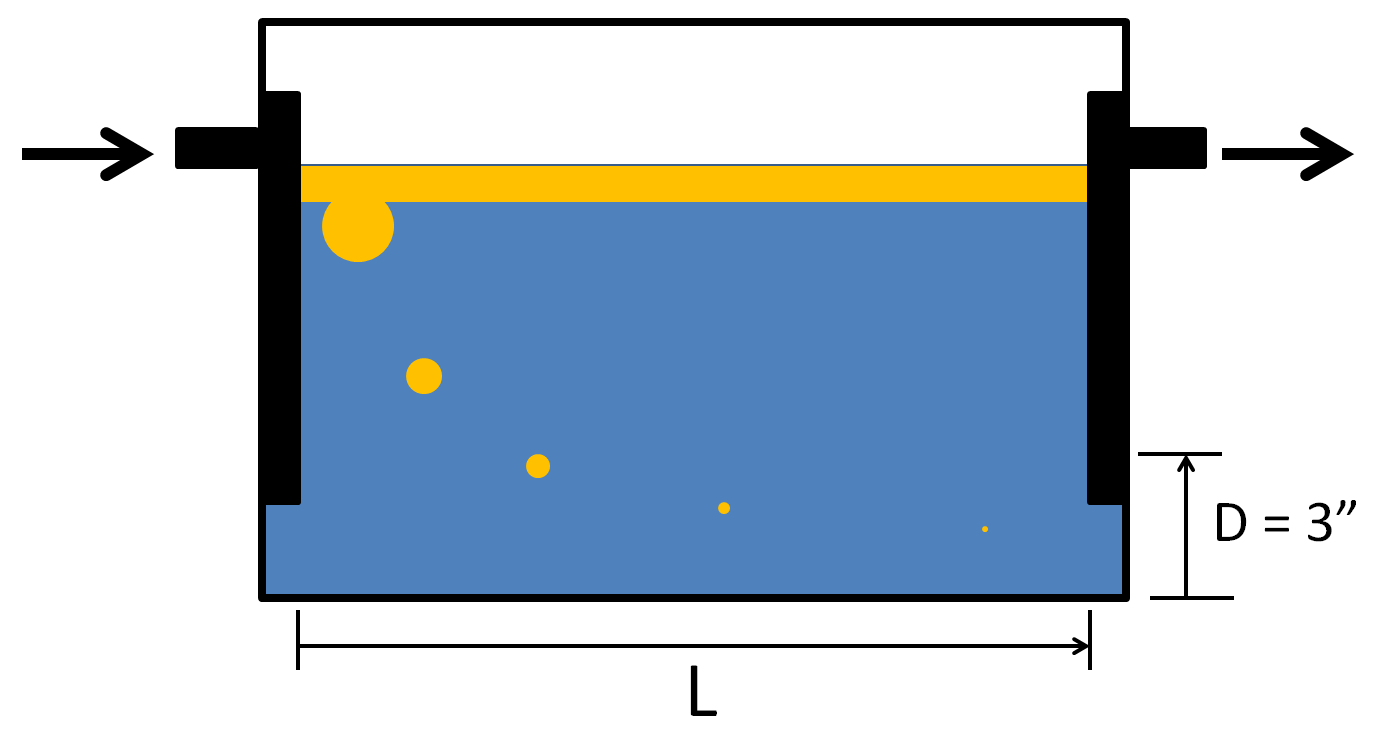
"For simplicity let us assume that pure grease and water enter near the bottom of a rectangular-shaped interceptor L feet long, B feet wide, and with a water depth of D feet.  The interceptor will do a good job of separation if, as the flow goes through the interceptor, the mean velocity of flow is such as to permit the grease globule to rise a vertical distance D in a length of L feet."

Dawson et al. went on to say, "If we neglect, for the moment, the presence of turbulence we see that the controlling item in the sizing of the interceptor for any particular rate of flow is the rate of rise of the grease globules. If the size of the globules is known, the maximum velocity of rise can be calculated readily from known principles of fluid mechanics, by equating the buoyant force on a globule to the force of fluid resistance."

If I keep quoting Dawson et al. we are all going to be asleep soon. So let me paraphrase from here. Velocity is the speed that the fluid is moving across the interceptor.  If the fluid moves too quickly the smaller grease globules are less likely to have time to rise an adequate distance to remain in the interceptor.  This makes velocity a key to good interceptor design.

The American Society of Plumbing Engineers (ASPE) established three inches as the minimum distance D that a grease globule must rise in a length of L in an interceptor to be retained (ASPE Plumbing Engineering Design Handbook 4, Plumbing Components and Equipment, Chapter 8 Grease Interceptors).

Gravity-differential separation applies to any grease interceptor regardless of manufacturer or type. HGIs must be designed based on this principle and so do GGIs.

No exceptions.

So what is the assumed difference?
That HGI's use controlled flow and some other stuff, most of which is bunk (counter-current flows, bernoulli's equation, etc.), to do what GGIs do with retention time.

Assumption debunked.

HGIs control the incoming flow and distribute it throughout the cross-sectional area reducing the fluid velocity to allow for gravity-differential separation at the maximum rated flow of the interceptor.

GGI's do not!

This is basic physics.

GGIs simply take whatever flow is dumped into them and everyone assumes that, no matter what, the GGI can handle it.

Sorry, it ain't possible.

Uncontrolled inlet velocity and the associated turbulence causes short-circuiting at higher flow rates in GGIs. This is not to say that GGIs don't work.  At lower flow rates they work very well because turbulence decay happens rapidly at low flow rates.  At higher flow rates though, turbulence decay happens over an exponentially longer time.

Experiments by the Water Environment Research Foundation, included in their 2008 report Assessment of Grease Interceptor Performance, demonstrated that residence times of at least one hour were more conducive to turbulence decay in the standard IAPMO approved GGI (Z1001) design.

When everyone finally steps back long enough to think clearly about how all grease interceptors must actually work - we will finally be able to start focusing on what is really important in an interceptor (hint - it isn't how much water it can hold).

When everyone starts focusing on how efficient a grease interceptor is and how much grease it can hold instead of how much water it can hold, we wont need to worry about whether its called an HGI or a GGI because all grease interceptors will be just grease interceptors.

HGIs will not hold just 2 lbs of grease for each 1 gpm of flow rate - because to keep up with competition, they will have to hold 5 times as much or 10 times as much or even more!

If GGIs are the FOG abatement solution of the future then the earth doesn't revolve around the sun and the moon doesn't revolve around the earth and we don't exist either, which is weird because my back hurts.

Monday, November 16, 2009

Grease Interceptors; Hydromechanical, what is that?

The 2006 Uniform Plumbing Code made some interesting changes in chapter 10 relating to grease traps that have some people confused.  Lets clear it up.

For years the term "Grease Trap" was used to define "A plumbing appurtenance or appliance that is installed in a sanitary drainage system to intercept nonpetroleum fats, oil, and greases (FOG) from a wastewater discharge."  The device was commonly used as a point of use interceptor servicing a specific fixture.  Until the 2006 code changes these devices were limited to a maximum of 4 drainage fixtures.

Now we have a new term "Hydromechanical Grease Interceptor".  It is defined as "A plumbing appurtenance or appliance that is installed in a sanitary drainage system to intercept nonpetroleum fats, oil, and greases (FOG) from a wastewater discharge and is identified by flow rate, and separation and retention efficiency.  The design incorporates air entrainment, hydromechanical separation, interior baffling, and / or barriers in combination or separately..."  These devices are required under the code to control the flow rate entering the device with either an external flow control or a built-in flow control (non-external), either directly connected or indirectly connected to the sewer system.

That definition may need a bit of explaining.  Lets simplify it.  A Hydromechanical Grease Interceptor is a device that separates and stores fats, oils, and grease (FOG) and is commonly used inside a restaurant for point of use grease separation.  These devices are "generally" installed inside.  Flow rates for these devices range from 10 gpm to 100 gpm.

Are all Hydromechanical Grease Interceptors alike?  The short answer is no.

Manufacturers have used the same old technology in grease traps for decades and the standard that has governed this type of grease interceptor is PDI-G101.  The basic design  requires the interceptor to have baffles inside (units are typically made out of steel) and an external flow control with an air vent.  The baffles are intended to extend the flow path while the vent (or air in-take) on the flow control provides a source of air to mix with the in-fluent as it enters the interceptor intended to aide in the separation process.  A certified device is required to separate two (2) lbs of grease for each one (1) gpm of the interceptors certified flow rate at a minimum of 90% average efficiency.  For example a 20 gpm unit is required to separated and store 40 lbs of grease and be at least 90% efficient up to the units rated capacity.


The plumbing code has another approved standard for Hyrdromechanical grease interceptors called ASME A112.14.3-2000.  This is an open standard that allows a manufacturer to be innovative, potentially developing designs that may be more efficient and separate more grease than the minimum requirements.

Schier Product's Great Basin Series and Thermaco's Trapzilla series are just two examples of manufacturers that have developed interceptor designs that are a significant departure from older technologies.  Both of these series are certified to ASME A112.14.3 Type C.  In both cases their designs could not be certified to PDI-G101 owing to their lack of an external vented flow control and internal baffling.  They also meet or exceed the minimum performance requirements of PDI certified interceptors.

Hydromechanical Grease Interceptors; the new term for a grease trap.